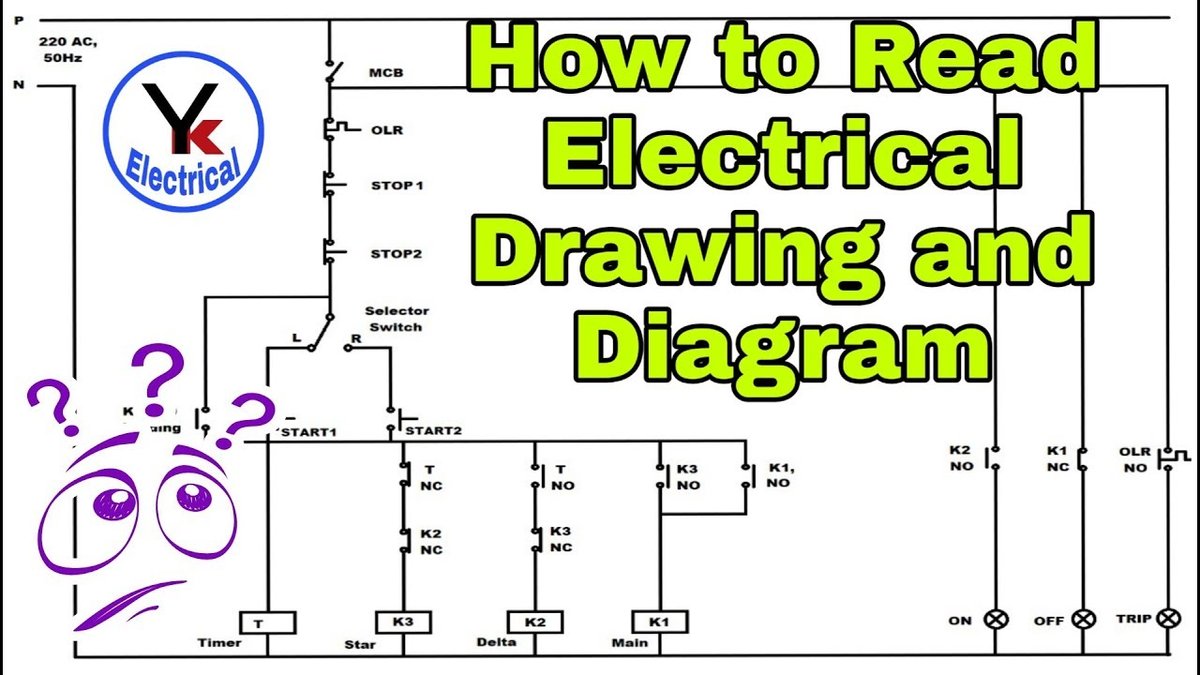
Ever found yourself staring at a tangle of wires, a malfunctioning circuit board, or a piece of equipment that just won't power up, wishing you had X-ray vision? While we can't grant superpowers, there's a widely accepted blueprint that comes pretty close to revealing the hidden lifeblood of any electronic device: the electrical schematic. Understanding and Interpreting Electrical Schematics isn't just a technical skill; it's your key to unlocking the secrets of circuits, empowering you to design, build, and, crucially, effectively troubleshoot electrical systems with confidence.
These detailed diagrams are the universal language for anyone working with electricity, from the hobbyist soldering their first circuit to the seasoned engineer designing complex industrial controls. Without them, you're merely guessing, fumbling in the dark. With them, you gain clarity, precision, and the ability to diagnose problems that would otherwise remain a frustrating mystery.
At a Glance: Your Schematic Superpowers Await
- Schematics are roadmaps: They show component locations and connections, telling you how a circuit is designed to work.
- Symbols are the alphabet: Learn the basic international symbols for resistors, capacitors, switches, and more.
- Lines are connections: They represent the wires and traces that carry current.
- Key concepts are your toolkit: Ohm's Law, component functions, and circuit types (series/parallel) are essential for interpretation.
- Practice makes perfect: Start with simple circuits, trace paths, and use a multimeter to verify your understanding.
- Troubleshooting is the payoff: Schematics guide you to isolate faults, predict voltages, and verify wiring efficiently.
The Blueprint of Electrons: What Exactly is an Electrical Schematic?
Imagine trying to build a house without architectural drawings, or assembling a complex piece of furniture without instructions. That's what working with electricity without a schematic feels like. An electrical schematic is a graphical representation of an electrical circuit, using a standardized set of symbols to depict components and the lines connecting them to illustrate their electrical relationships. It’s not a photograph of the circuit, nor is it a physical layout plan; instead, it focuses purely on the function and connectivity.
For engineers, technicians, and even dedicated hobbyists, schematics are indispensable. They convey the designer's intent, detailing every component, every connection, and every functional block. This visual shorthand allows experts worldwide to understand, collaborate on, and crucially, troubleshoot circuits by tracing the flow of power and signals, identifying potential points of failure before or during operation. It’s the closest you'll get to looking inside the electrons themselves.
Deciphering the Code: Key Elements You'll Encounter
Every schematic, regardless of its complexity, is built from a few fundamental elements. Mastering these is like learning the alphabet before you can read a book.
Symbols: The Language of Components
At the heart of any schematic are its symbols. These are standardized graphical representations of electrical and electronic components. A resistor isn't drawn as a physical tube with color bands; it's a zigzag line or a rectangle. A capacitor isn't shown as two metal plates; it's two parallel lines. This standardization is critical because it ensures that a schematic drawn in Tokyo can be understood by an engineer in Texas.
Common symbols you’ll quickly memorize include:
- Resistors: Limiting current flow (zigzag or rectangle).
- Capacitors: Storing charge (two parallel lines, one curved for polarized).
- Inductors: Storing energy in a magnetic field (coiled loops).
- Diodes: Allowing current in one direction (triangle against a line).
- Transistors: Amplifying or switching electronic signals (various shapes with three leads).
- Switches: Opening or closing a circuit (variations of an interrupted line).
- Sources: Batteries, power supplies (long and short parallel lines, circles with +/-).
- Ground: Reference point for voltage (various comb-like or triangular symbols).
As you gain experience, you'll encounter hundreds more, from integrated circuits to complex transducers. For a comprehensive visual guide to these fundamental building blocks, you can always View electrical symbols diagram. Familiarity with these visual cues is the first major step in making schematics less intimidating.
Lines & Nodes: Mapping the Connections
Think of lines on a schematic as the wires or traces on a printed circuit board (PCB). They illustrate the electrical connections between components.
- Connecting Lines: A solid line indicates a conductive path. When lines cross but don't connect, they typically just "jump" over each other without a dot.
- Nodes: When two or more lines do connect electrically, a small dot (often a solid circle) is placed at their intersection. This dot signifies a "node" – a point where multiple components or wires are electrically joined together. Ignoring these dots can lead to serious misinterpretations, as a simple line crossing without a dot means no connection.
Labels & Annotations: The Circuit's Backstory
Schematics don't just show what is connected; they provide crucial details about each component.
- Reference Designators: Each component typically gets a unique alphanumeric label, called a reference designator. For example, resistors might be R1, R2, R3; capacitors C1, C2; and transistors Q1, Q2. This allows you to identify specific parts when discussing the circuit or cross-referencing with a bill of materials.
- Component Values: Alongside the designator, you'll find the component's value – for a resistor, its resistance in ohms (e.g., "1kΩ"); for a capacitor, its capacitance in farads (e.g., "10µF"); for a diode, its part number. These values are essential for understanding component behavior and for sourcing replacements.
- Annotations and Notes: Designers often add textual notes, flags, or callouts to explain specific circuit behaviors, operating conditions, or special instructions. Don't skip these; they often contain vital context.
Power & Ground: The Circuit's Lifeblood
Every active circuit needs power. Schematics clearly delineate where power enters and where the circuit's common reference point (ground) is established.
- Power Symbols: These typically appear as arrows pointing into the circuit, often labeled with voltage values (+5V, +12V, VCC, VDD). These are the positive supply rails.
- Ground Symbols: Often represented by a series of horizontal lines of decreasing length, or a triangle, ground is the common return path for current and the 0V reference point against which all other voltages are measured. A robust understanding of power and ground distribution is fundamental to grasping a circuit's operation.
Your Fundamental Toolkit for Reading Schematics
Reading a schematic isn't just about identifying symbols; it's about understanding the underlying physics and principles that govern how a circuit functions. Arming yourself with a few key concepts will dramatically accelerate your interpretation skills.
Ohm's Law: The Golden Rule of Circuits
This is arguably the most fundamental principle in electrical engineering: V = IR.
- V (Voltage): The electrical potential difference, measured in Volts. It's the "push" or "pressure" that drives current.
- I (Current): The flow of electrical charge, measured in Amperes. It's the "amount" of electricity moving through a point.
- R (Resistance): The opposition to current flow, measured in Ohms.
Ohm's Law allows you to calculate any one of these values if you know the other two. It's crucial for understanding how current will flow through a resistor given a voltage, or what voltage drop you'll see across a component. When troubleshooting, you'll constantly be thinking, "If this resistor is 100 ohms and I measure 10V across it, then 0.1A (100mA) should be flowing through it." If your measurement differs, you've found a clue.
Component Principles: Knowing What Each Part Does
To interpret a schematic, you need to know the purpose of each component type.
- Resistors: Always resist current. They dissipate power as heat, drop voltage, and limit current.
- Capacitors: Store electrical energy in an electric field. They block DC current but allow AC to pass, effectively smoothing voltage or filtering signals. Polarized capacitors must be connected with the correct polarity (+ to +, - to -).
- Inductors: Store energy in a magnetic field. They oppose changes in current, acting as filters or energy storage elements in power supplies.
- Diodes: Unidirectional valves. They allow current to flow in one direction (forward bias) and block it in the other (reverse bias). LEDs are light-emitting diodes, also polarized.
- Transistors: Act as electronic switches or amplifiers. Understanding their base/gate, collector/drain, and emitter/source terminals is key to seeing how they control current.
- Integrated Circuits (ICs): These are complex mini-circuits within a single package. For ICs, you'll often refer to their datasheet (more on this later) to understand pin functions and internal logic.
Series vs. Parallel: How Components Team Up
Components are connected in one of two fundamental ways:
- Series Circuits: Components are connected end-to-end, forming a single path for current. The current is the same through every component, but the voltage drops add up across them. If one component breaks (opens), the entire circuit path is interrupted.
- Parallel Circuits: Components are connected across the same two points, creating multiple paths for current. The voltage across each parallel component is the same, but the total current is the sum of currents through each branch. If one component breaks, current can still flow through the other branches.
Recognizing these configurations is vital for predicting voltage and current distribution throughout the circuit.
Circuit Flow: Tracing the Path of Power and Signal
When you read a schematic, you're not just looking at a static picture; you're imagining dynamic flow.
- Power Flow: Typically, current flows from the positive terminal of the power supply, through the various components, and back to the negative terminal (ground).
- Signal Flow: In many electronic circuits (especially audio or data circuits), you'll also trace the "signal path" – how an input signal (like an audio wave) travels through amplifiers, filters, and processors to an output. Schematics often have signals flowing generally from left to right, or top to bottom.
SI Units & Polarities: The Details That Matter
Precision matters in electronics.
- SI Units: Be familiar with standard international units: Ohms (resistance), Farads (capacitance), Henrys (inductance), Amperes (current), Volts (voltage), Watts (power), Hertz (frequency).
- Polarity: Critical for components like diodes, LEDs, electrolytic capacitors, and many ICs. Connecting these with reversed polarity can prevent the circuit from working, or worse, destroy the component. Schematics clearly mark the positive (+) and negative (-) terminals or cathode/anode orientations.
Real-World Application: Multimeters and Datasheets
While schematics are your map, you'll need tools to confirm your interpretations in the physical world.
- Multimeter: This essential tool allows you to measure voltage, current, and resistance at various points in a live circuit. You'll compare your multimeter readings to the values predicted by the schematic to identify discrepancies.
- Datasheets: For complex components, especially ICs, the schematic might only show the part number. The component's datasheet (provided by the manufacturer) contains critical information: pin descriptions, absolute maximum ratings, typical operating characteristics, and example application circuits. It's your deep dive into a specific component's behavior.
Beyond the Standard: Different Types of Circuit Representations
While the generic "schematic diagram" is most common, several other visual representations serve different purposes, offering varying levels of detail.
Block Diagrams: The Big Picture View
A block diagram is the most simplified representation of a system. It shows the main functional blocks (e.g., "Power Supply," "Microcontroller," "Amplifier," "Output Stage") and how they connect to each other. Internal details of each block are omitted. This type of diagram is excellent for understanding the overall system architecture and fundamental function without getting bogged down in individual component details. It's a high-level overview, focusing on what each part does rather than how it does it.
Schematic Diagrams: The Nitty-Gritty Detail
As discussed, this is the most common and detailed type for individual circuits. It displays every component, every connection, and their arrangement using standard symbols and labels. Each component has its unique alphanumeric label (R1, C5, U2, etc.). This is the diagram you'll use for circuit design, assembly, and detailed troubleshooting. If you need to know exactly which resistor connects to which transistor, this is your go-to.
Single-Line Diagrams: Simplified System Overviews
Often used in power distribution or industrial control systems, a single-line diagram (also known as a one-line diagram) provides a simplified, general overview of a complex electrical system. Instead of showing every conductor for multi-phase AC power, a single line represents the entire circuit or a bundle of conductors. Symbols are simplified, but they still convey how major components like generators, transformers, circuit breakers, and loads are interconnected. They're useful for understanding the overall power flow and major equipment without the clutter of every individual wire.
Multi-Line Diagrams: Every Wire Accounted For
In contrast to single-line diagrams, multi-line diagrams (also called elementary diagrams or ladder diagrams in control systems) show every single conductor and connection in intricate detail. For a three-phase motor, you'd see all three phase wires, plus ground and control wires. These are crucial for installing, diagnosing, and repairing complex electromechanical systems where precise wiring and fault diagnosis require complete information on every connection. They can be visually dense but leave no room for ambiguity regarding wiring paths.
Pictorial Diagrams: A Beginner's Visual Guide
Pictorial diagrams are less common in professional engineering but are very helpful for beginners or in simple consumer electronics repair manuals. Instead of abstract symbols, components are drawn to look like their actual physical appearance, and wires are shown connecting them. This can be easier for someone without formal electrical training to grasp, as it directly maps the diagram to the physical components they see. However, they lack the precision and standardization of schematic diagrams and become unwieldy for complex circuits.
Step-by-Step: How to Read and Interpret Any Schematic
Now that you're armed with the basics, let's walk through the process of actually reading a schematic. It's a systematic approach, not a random scan.
- Start with the Power Supply: Locate the power source (battery, AC input, DC rails like +5V, +12V, or VCC) and the ground symbol. This establishes the circuit's operating voltage and its reference point.
- Follow the Current Path: Begin at the positive terminal of the power supply and mentally (or physically with your finger) trace the path of current.
- Identify Main Paths: Look for primary power distribution lines and main signal paths.
- Trace Through Components: As you encounter each symbol, identify the component, recall its function, and visualize how it affects the current or voltage (e.g., a resistor limits current, a switch opens or closes a path).
- Note Voltage Drops/Changes: Understand that voltage will change as it passes through components, especially resistors, diodes, and transistors.
- Identify Inputs and Outputs: Where does the signal enter the circuit? Where does it leave? Understanding these entry and exit points helps frame the circuit's overall purpose.
- Recognize Sub-Circuits or Functional Blocks: Complex schematics are often designed in modular blocks (e.g., an input filter, an amplifier stage, a power regulation section). Try to identify these sub-circuits, as understanding their individual functions helps you grasp the whole.
- Look for Recurring Patterns: Many circuits use common configurations (e.g., voltage dividers, filter networks, amplifier stages). Recognizing these patterns makes interpretation faster.
- Deconstruct an Example (Amplifier Circuit):
- Let's consider a simple audio amplifier stage. You might see an input signal coming through an input capacitor (C2). Its job is to block any DC voltage from the input source while allowing the AC audio signal to pass.
- The signal then hits the base of a transistor (Q1), which is biased by a network of resistors (R3, R2) to set its operating point. These resistors establish the correct voltage for the transistor to amplify effectively.
- Another resistor and capacitor (R1, C1) might be connected to the emitter, possibly for stability or to set the gain.
- The amplified signal exits the collector of the transistor and might pass through a load resistor (R4).
- Finally, an output capacitor (C3) at the end would again block DC from the output, sending only the amplified AC audio signal to the next stage or a speaker.
By tracing this path and understanding each component's role, you can see how the small input signal is boosted into a larger output signal.
Designing for Clarity: What Makes a Professional Schematic?
While you're learning to read schematics, it's worth understanding the principles behind good schematic design. A well-designed schematic is inherently easier to read and troubleshoot.
- Logical Organization: Components are generally laid out to reflect the flow of current or signal, often from left-to-right (input to output) and top-to-bottom (power to ground). Power rails are typically at the top, and ground at the bottom.
- Clear Wiring: Wires are drawn neatly, avoiding unnecessary bends or crossovers. When lines do cross without connecting, they should clearly "jump" over. Connections are always marked with a dot.
- Effective Labeling: All components have clear reference designators and values. Net labels (names given to specific electrical connections or "nets") are used judiciously to reduce spaghetti wiring on busy diagrams, routing specific signals or buses without drawing every physical line.
- Termination Points: Input/output connections, test points, and off-board connections are clearly marked with appropriate symbols or labels, often indicating where they connect to other parts of a larger system.
- Zones and Pages: For very large circuits, the schematic might be broken into multiple pages or "zones," each representing a functional block, with clear indications of how signals connect between pages.
Troubleshooting Like a Pro: Using Schematics to Diagnose Faults
This is where your schematic interpretation skills truly pay off. A schematic isn't just a diagram; it's your troubleshooting roadmap.
- Isolate the Problem Section: If a device fails, the schematic helps you quickly narrow down the possible fault location. Instead of randomly probing, you can use the block diagram (if available) or the overall schematic layout to identify which functional area might be causing the issue (e.g., "Is it the power supply, the amplifier, or the control logic?").
- Check Expected Voltages and Currents: The schematic, combined with Ohm's Law and component knowledge, allows you to predict what voltages and currents you should measure at various test points. If you expect +5V at a certain node and measure 0V, you know there's a problem upstream. Similarly, if you expect a specific current through a resistor and measure something drastically different, you've found a clue.
- Verify Connections and Continuity: Use your multimeter's continuity function to check if connections shown on the schematic actually exist in the physical circuit. Are all pins of an IC connected as indicated? Is there an unexpected short circuit between two lines that shouldn't be connected? Is there an open circuit (a broken wire or trace) where there should be continuity?
- Confirm Component Polarity and Values: Schematics clearly show polarity for components like diodes and electrolytic capacitors. If these are inserted backward in the physical circuit, they won't work and may even be damaged. You can also use your multimeter to check resistor values (when the circuit is off and components are isolated) against the schematic.
- Follow the Signal Path: For signal-based circuits, use an oscilloscope or logic analyzer to trace the signal. Does the signal enter the amplifier correctly but fail to appear at the output? The fault is likely within that amplifier stage. The schematic guides your probing points.
Common Pitfalls to Avoid:
- Assuming Component Health: Don't assume a component is good just because it looks okay. A resistor can drift in value, a capacitor can short or open, a semiconductor can fail.
- Ignoring Polarity: Reversing polarized components is a common mistake for beginners and can cause irreversible damage.
- Misinterpreting Crossings vs. Connections: Always look for the dot indicating a connection.
- Not Accounting for Loading: Your multimeter probes can sometimes affect sensitive circuits. Be aware of measurement limitations.
Your Next Steps: Practice, Practice, Practice
Like learning any new language, becoming fluent in schematics requires immersion and consistent practice.
- Start Simple: Don't jump straight to complex microprocessor boards. Begin with very basic circuits: an LED with a current-limiting resistor, a simple switch circuit, a battery charger. Find their schematics and trace every connection.
- Build and Verify: The best way to learn is by doing. Build a simple circuit from a schematic. Then, use your multimeter to measure voltages and currents at various points, comparing them to what the schematic (and Ohm's Law) tells you should be there. This hands-on verification solidifies your understanding.
- Draw Your Own: Try to sketch a schematic for a simple device you own, like a flashlight or a USB charger. This forces you to think about how components interact and how to represent them clearly.
- Explore Online Resources: The internet is brimming with tutorials, interactive schematic readers, and vast libraries of component datasheets. Websites like Falstad's Circuit Simulator allow you to build and run virtual circuits and see current flow in real-time.
- Don't Be Afraid to Ask: If you're stuck on a particular symbol or circuit section, reach out to online electronics communities or forums. Explaining your confusion can often clarify it, and getting an expert's perspective is invaluable.
Mastering electrical schematics is a journey, not a destination. With each circuit you interpret and each fault you diagnose, you'll gain a deeper appreciation for the intricate dance of electrons and the powerful language that makes it all comprehensible. So, grab a schematic, fire up your imagination, and start tracing those lines – the world of electronics is waiting for you to unlock its secrets.